On the afternoon of October 31, 2025, CUFE Business School held the 4th Lecture of the 1st Phase (2025) of the PhD Research Competence Enhancement Program in Conference Room 602.The lecture invited Assistant Professor Chen Jingchuan from the Department of Supply Chain and Operations Management, CUFE Business School, as the keynote speaker. He shared the basic principles of large language models and their applications in business research with the participants. Nearly 20 members of CUFE Business School attended the lecture, and Associate Professor Dou Chao, Director of the PhD Program at CUFE Business School, planned and organized the event.The PhD Research Competence Enhancement Program is a featured initiative launched by CUFE Business School to improve the research capabilities of doctoral students. Implemented through a combination of "lectures + tutoring", the program covers all core processes of academic research. It runs once per academic year, with each phase including several lectures across multiple professional directions. The topics covered include research topic selection, literature review, research design, methodological techniques, paper writing, and paper submission and revision.
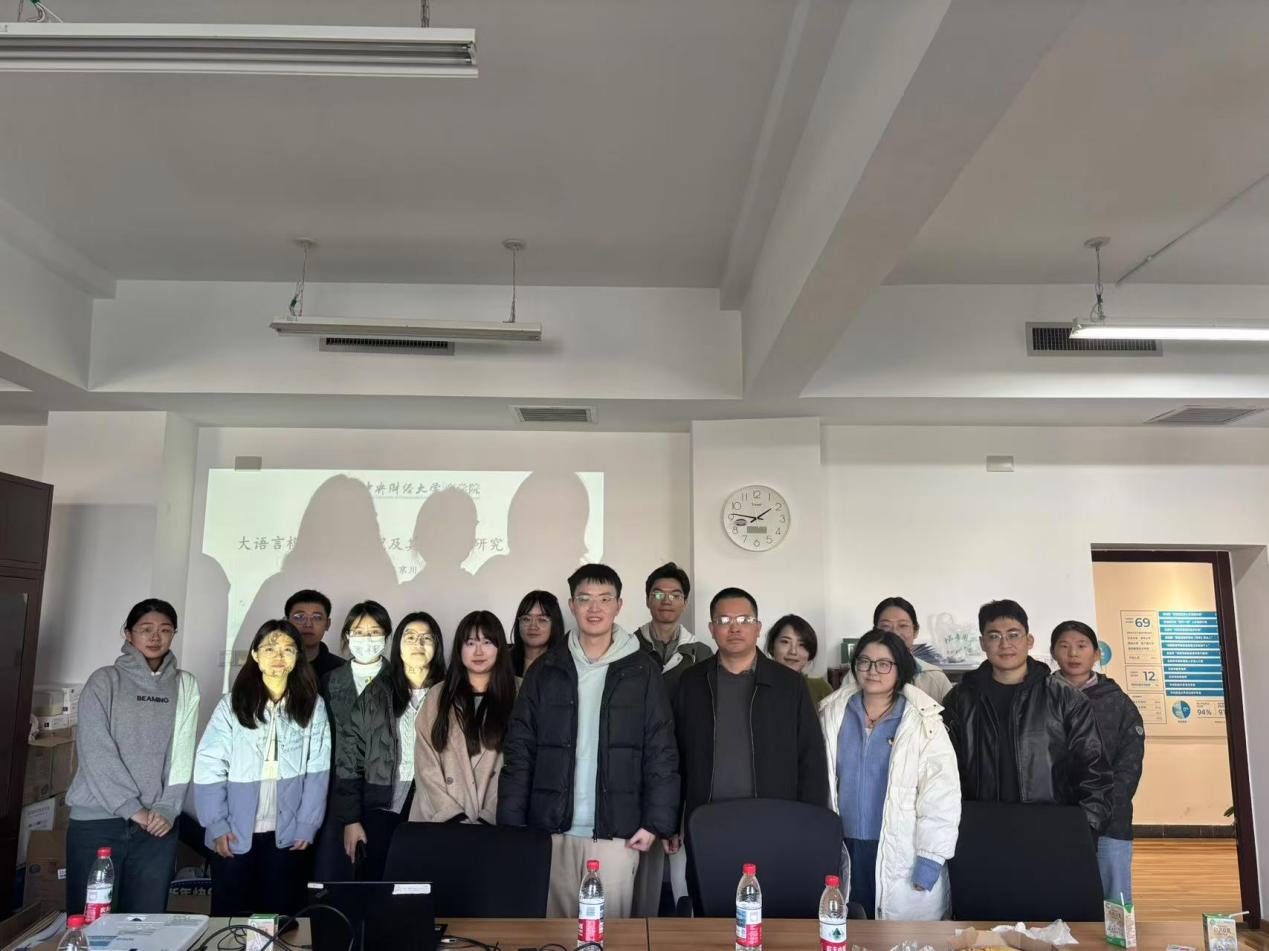
The lecture was hosted by Associate Professor Dou Chao, Director of the PhD Program at CUFE Business School. At the outset, Professor Dou gave a brief introduction to the keynote speaker, Assistant Professor Chen Jingchuan.Assistant Professor Chen Jingchuan boasts a solid academic background. He obtained his bachelor's degree from the Faculty of Information Technology at Beijing University of Technology, his master's degree from the School of Automation at Beijing Institute of Technology, and his doctoral degree from the Department of Data and Systems Engineering at the University of Hong Kong. Currently, he serves as an Assistant Professor in the Department of Supply Chain and Operations Management at CUFE Business School. His main research interests include operations management, data-driven optimization, applications of large language models in operations research, and production system optimization.
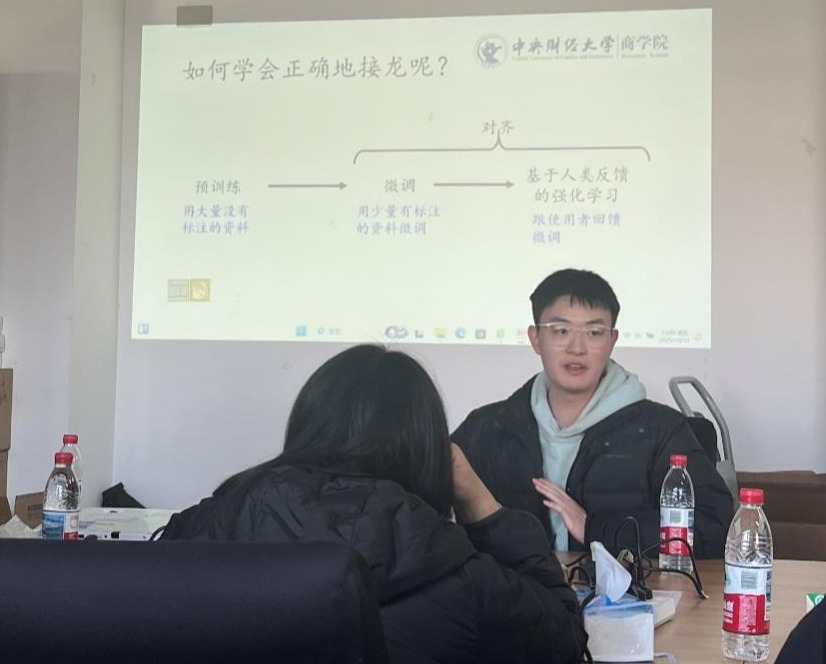
Starting from the current status and challenges of business research, Assistant Professor Chen Jingchuan conducted an in-depth discussion on the new opportunities brought by artificial intelligence technology to business research. During the lecture, Professor Chen revealed the underlying logic of large language models (LLMs) through vivid and vivid metaphors."Essentially, a large language model is an extremely complex text continuation system. It gradually generates coherent text content by predicting the most likely next word." This easy-to-understand metaphor helped the students quickly grasp the basic working principle of large language models.Professor Chen further elaborated on the detailed operation process behind large language models, including key links such as model training, optimization, and inference. He specifically pointed out that the randomness of LLM outputs stems from their probabilistic nature: "Just like rolling dice, the model selects outputs from a probability distribution every time. This explains why the same prompt may lead to different responses."When introducing the learning mechanism of artificial intelligence, Professor Chen summarized it into three main sources. Firstly, there is network data, which serves as the cornerstone for the model to acquire massive amounts of knowledge. Secondly, annotated data helps the model better understand professional knowledge in specific fields. Finally, user feedback is a mechanism that enables the model to continuously optimize and improve.The lecture concluded with a focus on the much-discussed prompt engineering. The keynote speaker emphasized that a high-quality prompt is like a bridge for communicating with artificial intelligence, which can significantly enhance the quality of interaction and the effectiveness of output.
This sharing session provided the attending doctoral students with cutting-edge research perspectives and methodological insights. The lecture systematically elaborated on the innovative application of artificial intelligence in business research, demonstrating that it is not only a powerful analytical tool but also an important driving force for promoting the paradigm transformation of business research.Through this series of lectures, the school has further helped the current doctoral students clarify the core ideas of empirical research and the key skills of thesis writing, providing strong support for the efficient advancement of scientific research work, and has been highly praised by teachers and students.



