At 2:00 PM on Friday, October 31, 2025, CUFE Business School successfully held the 28th 2025 Excellent Academic Forum in Conference Room 615 of the Main Teaching Building at the Xueyuannan Road Campus. The lecture invited Associate Professor Yu Chunyang from China Academy of Art as the keynote speaker. More than 20 participants, including teachers, doctoral students and master's students from CUFE Business School, attended the event.
The meeting was hosted by Associate Professor Mu Shandong, Director of the Department of Supply Chain Management at CUFE Business School. Before the lecture, Professor Mu briefly introduced Professor Yu Chunyang's academic background. Currently, Professor Yu serves as Associate Professor and Master's Supervisor at China Academy of Art, Assistant Director of the Philosophy and Social Sciences Laboratory for Cultural and Creative Design and Intelligent Manufacturing of the Ministry of Education, Deputy Secretary-General of the Yangtze River Economic Belt Innovative Design Industry Alliance, and Deputy Director of the AIGC Expert Committee of Zhejiang Artificial Intelligence Society. He is also a cultivated talent under the Hangzhou High-Level Talent Special Support Program. His main research directions focus on intelligent design and manufacturing systems. He has presided over and participated in more than 10 national and provincial-level projects, published over 30 SCI/SSCI papers, served as Associate Editor of the Journal of Engineering Design, and acted as a reviewer for multiple international authoritative journals.
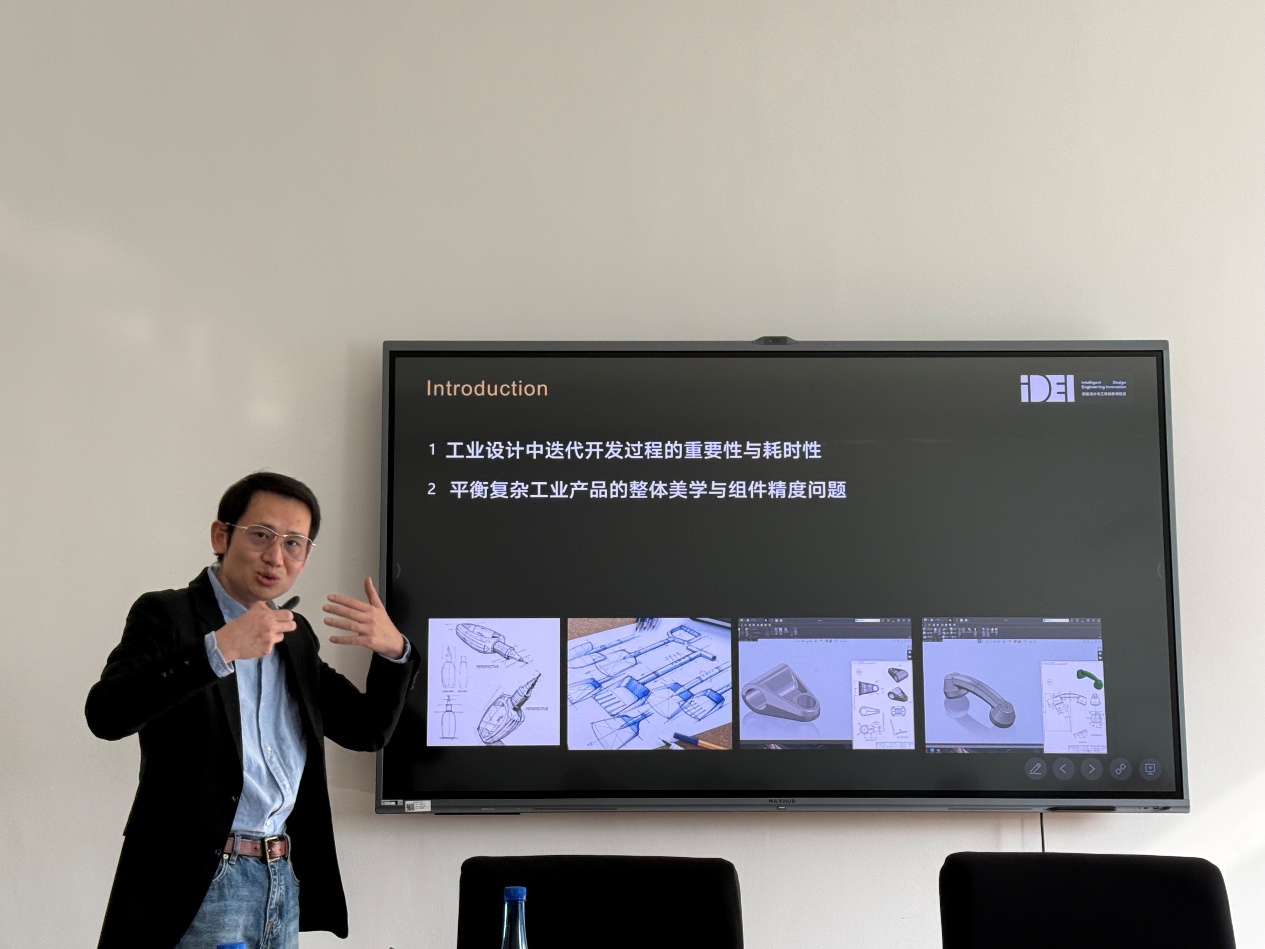
The theme of Professor Yu Chunyang's lecture was "Generative Design Reconstruction and Innovation Management of Industrial Products Based on RAG Engine". In the human-centric Industry 5.0 era, machines should transform from tools into creative partners that collaborate deeply with designers. However, current human-machine collaboration systems generally face the bottlenecks of "cognitive dissonance" and "regulatory instability". This challenge is particularly prominent in the design of complex products: balancing overall aesthetics and local functions has always been a time-consuming and inefficient process. Traditional methods struggle to coordinate effectively, leading to workflow disruptions. To address this challenge, Professor Yu introduced the forward-looking Meta-XDesign (MXD) theoretical framework and its practical case BrepRAG. MXD is not merely about creating a better AI tool, but about designing an entirely new human-machine collaborative relationship. The MXD framework aims to build an AI partner capable of understanding, reasoning, and growing together with designers, thereby truly unlocking the potential of human-machine co-creation to meet the higher requirements for innovation, efficiency, and humanism in the Industry 5.0 era. Its powerful practical case, BrepRAG, integrates Retrieval-Augmented Generation (RAG) with industrial-standard Brep model conversion, enabling AI to understand and respond to designers' deep intentions. It allows designers to refine local components while maintaining the integrity of the overall design, seamlessly reconciling macro aesthetics with micro precision. Supported by a global scheme scoring mechanism to accelerate decision-making, the framework has been verified to significantly reduce iteration cycles while achieving superior design outcomes. As a successful application under the Meta-X architecture, BrepRAG lays a solid foundation for building the next-generation design ecosystem driven by human-machine collaboration to deliver transformative solutions.
After the lecture, teachers and students present launched in-depth and enthusiastic discussions around the theme of Professor Yu Chunyang's sharing, further deepening the exchange between academia and practice.

As an important platform for CUFE Business School to fulfill its mission of "contributing new management knowledge", the "Excellent Academic Forum" is committed to focusing on cutting-edge issues in the field of business administration and Chinese enterprise management practice. It gathers global wisdom and innovative perspectives to provide theoretical support and practical paths for promoting the sustainable development of Chinese society and economy.



